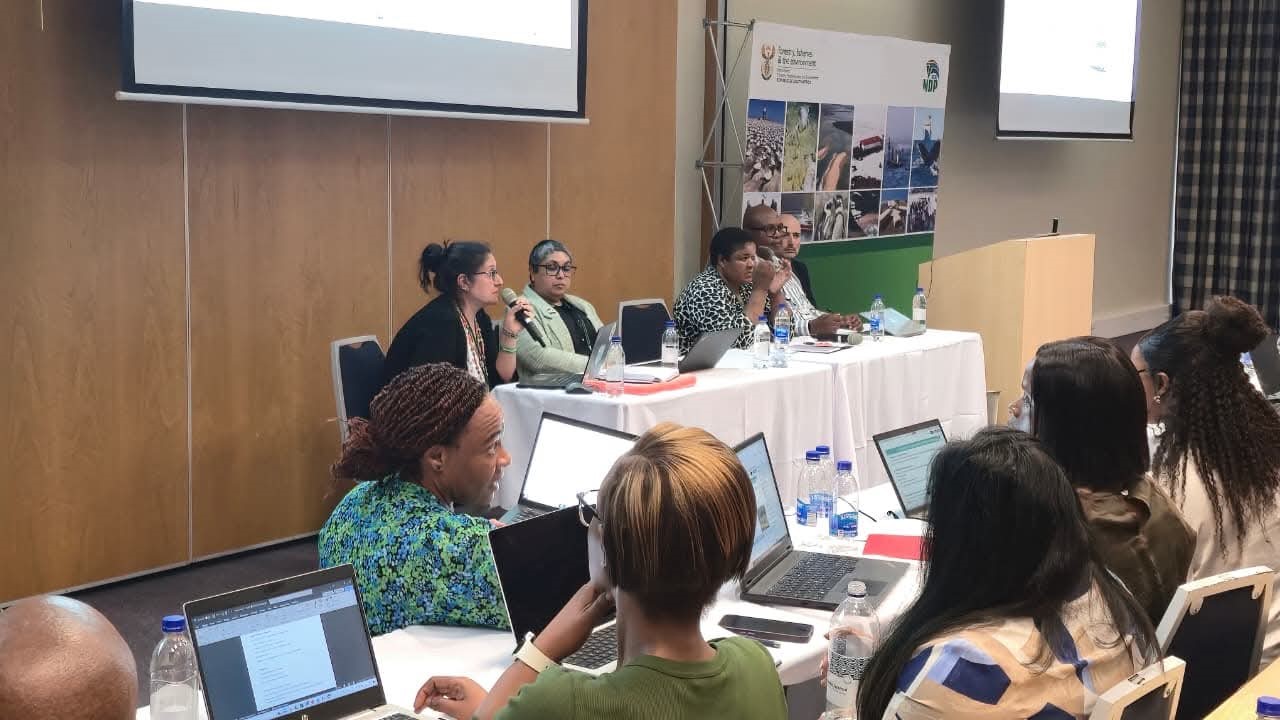
Short Report: ICM Lekgotla 2025 – Day 2 Panel on Nature-Based Solutions
By Professor Francesca Porri
The Integrated Coastal Management Lekgotla 2025, hosted by the DFFE, took place at the East London IDZ from 24-26 November 2025, centred around the theme “Working with Nature – Blue & Green Pathways to Resilience.” A key highlight of day two was the high-level panel discussion on South Africa’s approach to Nature-Based Solutions (NbS) and Ecosystem-Based Adaptation (EbA), facilitated by Mr Barney Kgope (DFFE). The panel brought together experts from national government, academia, development finance institutions, and municipalities to examine how South Africa can strengthen its transition from policy frameworks to practical, scaled NbS interventions.
Representing the National Research Foundation – South African Institute for Aquatic Biodiversity (NRF-SAIAB), Prof. Francesca Porri contributed as one of the country’s leading scientists in ecological engineering and nature-based solutions for the built coastal infrastructure. Her input emphasised the critical role of science-based design and evidence-led implementation in shaping NbS that are effective, scalable, and resilient under accelerating climate change.
Prof. Porri highlighted that South Africa’s rapid coastal urbanisation has led to the proliferation of grey infrastructure, ports, seawalls, marinas, which often creates degraded “novel ecosystems.” Drawing on her extensive research, including contributions to the World Harbour Project and the IMIsEE initiative, she demonstrated how Greening of Grey Infrastructure (GGI) offers a viable pathway to restoring ecological integrity while enhancing the performance of coastal built structures. She explained how eco-engineered surfaces, increased microhabitat complexity, and the integration of habitat-forming species can: reduce wave overtopping and buffer hydrodynamic energy, mitigate thermal, desiccation, and light stressors, enhance biodiversity, and strengthen ecosystem functioning (e.g., filtration, structural stabilisation).
A major theme in her intervention was the need for long-term and context-specific scientific monitoring. She stressed that most existing NbS/GGI trials are short-term, and South Africa must invest in multi-site, multi-year data to understand variations across hydrodynamic and climatic gradients. Monitoring shoreline change, ecosystem health indicators, and climate hazard modelling is essential to ensure that municipalities and engineers design NbS interventions that match local conditions. Prof. Porri also cautioned that without independent evaluation and robust data, the risk of “greenwashing” remains high.
The panel discussion collectively pointed toward emerging opportunities in policy refinement, innovation, financing mechanisms, and community engagement. Yet Prof. Porri’s contribution underscored that science must remain at the centre of South Africa’s strategic NbS agenda, ensuring that coastal adaptation solutions are not only nature-positive, but also technically sound, measurable, and durable.
Her participation showcased the growing national leadership of NRF–SAIAB in bridging ecological research, engineering practice, and coastal policy. It also reinforced South Africa’s potential to become a regional leader in nature-positive coastal development, provided that NbS are grounded in rigorous evidence, coordinated governance, and meaningful local partnerships.