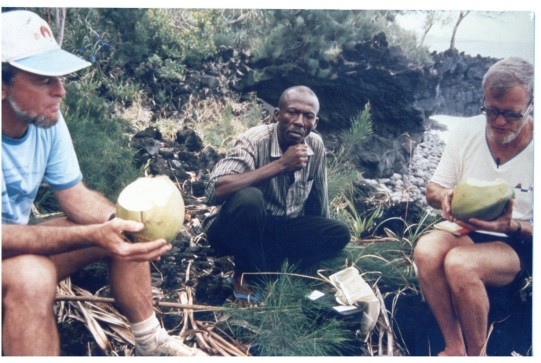
After decades of sharing science beyond the laboratory and research community, NRF-SAIAB’s Honorary Research Associate and former Director of SAIAB (1982–1994) Professor Mike Bruton has been recognised with the National Science and Technology Forum (NSTF) Science Communicator Award. The award recognises individuals who make science, engineering, technology and innovation easier for the public to understand, with the category considering work carried out over the past five years. Often referred to as the “Science Oscars of South Africa”, the NSTF awards recognise contributions to the country’s science, technology and innovation landscape.
Receiving the award was particularly meaningful for Professor Bruton, coming during his retirement years and recognising an aspect of his career that has always been important to him. “This award meant a great deal to me, especially late in my retirement years,” he says. He believes retired scientists are well positioned to continue sharing their knowledge with the public, helping to “demystify” science and make it more accessible. Professor Bruton’s relationship with science communication goes back to the early stages of his career. One of his earliest experiences involved explaining what he and his colleagues were discovering at Lake Sibaya in northern Zululand to young amaThongans, using patterns scratched into the sand. Since then, he has continued to make time to communicate science to people outside the scientific community. Importantly, he does not see this as something that took away from his research. Instead, he says, “it enhanced it.”
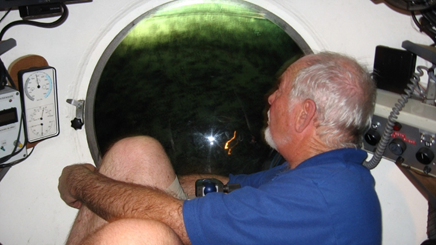
Professor Mike Bruton in the Jago submersible observing coelacanths at a depth of 198m off Grand Comoro island in the Comoros.
His approach to communicating science has also evolved considerably. Over the years, Bruton has moved beyond traditional talks to explore museum displays, interactive science centres, interviews, books, popular articles, debates, hands-on workshops and science theatre. He has also collaborated with professional actors David Muller and Nicholas Ellenbogen on innovative science communication projects. Professor Bruton says finding different ways to reach people is key, particularly when it comes to audiences who may not immediately see themselves as interested in science. He has explored the relationship between science and other creative fields, including “science and art, the art of science, or the science of music.” This work is especially important in South Africa, where educational imbalances continue to affect access to science education. Professor Bruton believes science communicators help bridge the gap between scientific knowledge and the wider public, particularly at a time when scientific advances are happening faster than many people can keep up with.
One of the challenges, he says, is the perception that science is simply too difficult to understand. This can create a barrier that discourages people from engaging with science, even though he believes everyone needs a basic understanding of science and its value to society. Professor Bruton believes scientists themselves can also do more to make their work accessible. Rather than remaining within their specialised areas, researchers should look for ways to explain the broader principles of science and how different disciplines connect with one another. He also encourages scientists to relate their research to current affairs and issues that people encounter in their everyday lives. Science communication is still very much an ongoing journey for Professor Bruton. He plans to continue with a number of projects that use creative approaches to introduce people to science and environmental issues. Among these is the Darwin project in Cape Town, which saw a bronze bust of a young Charles Darwin permanently placed on Simon’s Town Jetty. The project demonstrated to Professor Bruton that science communication can reach audiences who may not ordinarily engage with scientific topics. He describes it as “a real eye-opener” because it introduced many people to science and evolution who otherwise may have had little interest in either. Together with sculptor Johan Steyn, Professor Bruton is also planning a giant stainless-steel sculpture of a praying mantis, known as !Kaggen to the San people, at the entrance of the new First Nations Centre in Riverlands, Cape Town. Another planned sculpture of a dying honeybee at Kirstenbosch National Botanical Gardens will highlight the concerning decline of insects, which Professor Bruton describes as “the engine rooms of the planet”. The coelacanth, too, remains an important part of his science communication toolkit. Professor Bruton says he will “unashamedly continue to use the coelacanth as a teaching tool as its discovery has been one of the most remarkable episodes in the history of science”.
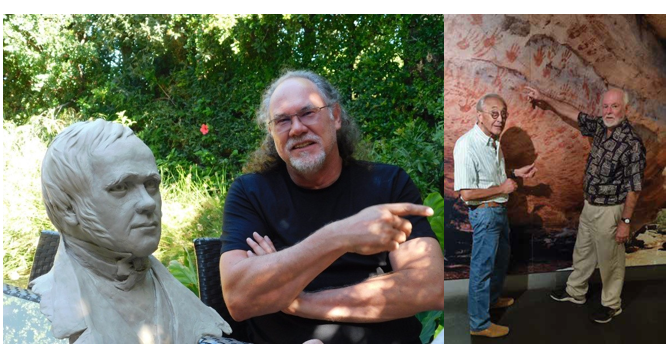
LEFT: The scultpor Johan Steyn with the clay marquette of the Darwin bust. RIGHT: Professor Mike Bruton and Dr Ruud Lapre studying San rock art in the Cederberg.
Professor Mike Bruton’s advice to young scientists is straightforward, “start communicating now rather than waiting for the perfect opportunity”. “Don’t procrastinate,” he says, encouraging scientists at any stage of their careers to begin sharing their work with others. He suggests starting with family or friends, attending talks that popularise science and learning from the process. Most importantly, he encourages young scientists not to be discouraged by early setbacks, reminding them that “Every failure is an opportunity to learn.” For Professor Bruton, the value of science communication ultimately extends beyond explaining research. He hopes his work encourages people to see science as a meaningful and exciting part of everyday life, alongside culture, music, dance, literature and sport. At the heart of this is curiosity, something he believes people should carry with them throughout their lives. “Don’t grow out of your childlike curiosity,” he says. “Start in your back garden.”