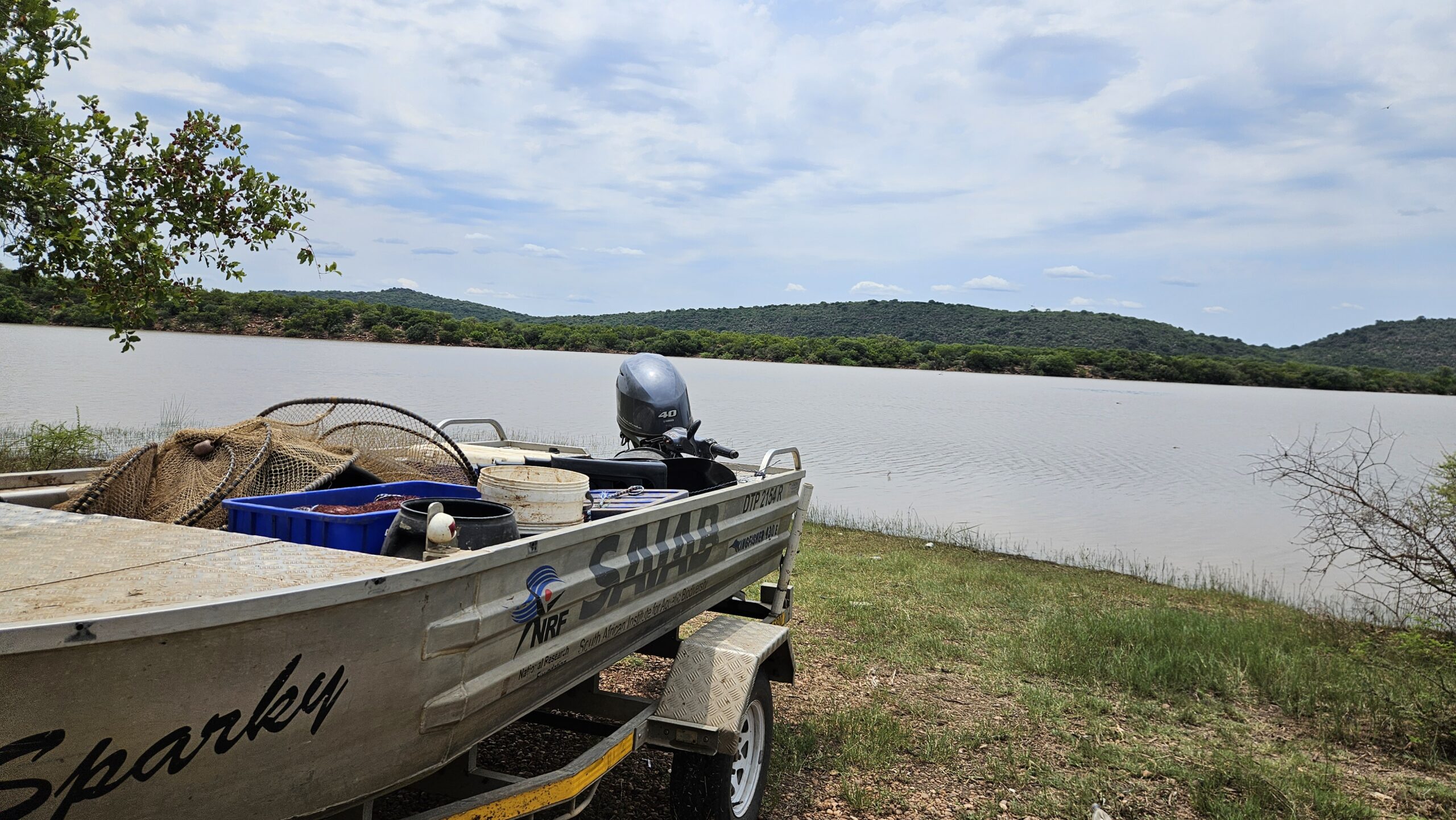
When a dam almost runs dry, what happens to the fish living in it and to the people who rely on it? This scenario was observed during fisheries surveys at Glen Alpine Dam, on the Mogalakwena River in Limpopo, near Wonderkop Nature Reserve.
The dam supplies water for irrigation and provides fishing opportunities for local communities. But changing water levels can transform underwater habitats and affect where people can fish.
Between May 2024 and February 2025, researchers surveyed the dam four times as water levels fell dramatically and then recovered. Department of Water and Sanitation records show that storage dropped from 52% of capacity in May to about 2% in November 2024. After summer rainfall, the dam had refilled by February 2025.
At the lowest point, large areas of the dam bed were exposed, with only shallow water remaining near the wall. Researchers also observed a high number of dead fish. This confirmed that fish mortality occurred during the period of severe water loss, although the available information could not establish exactly what caused it.
The team measured water quality, including turbidity (how cloudy the water is) and dissolved oxygen. Turbidity was measured using an instrument called a nephelometer, which shines light through a water sample to measure how much light is scattered by particles in the water. Average turbidity rose from about 3.7 Nephelometric Turbidity Units (NTU) in August to 47 NTU in November and 102 NTU in February. This showed that the water became much cloudier after the dam refilled. Dissolved oxygen was lowest in August. As measurements were taken during only four visits, they cannot show every change that may have occurred between surveys.
Researchers recorded 13 fish taxa (types) during the study. Four species made up about 87% of the total weight of fish caught: Butter catfish (Schilbe depressirostris), Limpopo Bulldog (Marcusenius krameria), African sharptooth catfish (Clarias gariepinus) and Mozambique tilapia (Oreochromis mossambicus). These catches show which species were present, but not how many fish live in the whole dam or how many could safely be caught each year. More consistent surveys are needed to answer those questions.
The researchers also interviewed eight local fishers. Those interviewed described losing access to familiar fishing areas and having fewer opportunities to fish as the water receded. Their experiences show that changing water levels affect more than wildlife: they can disrupt people’s activities and potential sources of food and income.
So, can Glen Alpine Dam sustain a fishery? It is too early to say. Refilling restored the water, but does not automatically mean fish populations have recovered. Researchers need to establish whether fish survive, reproduce and grow, and whether young fish replenish the population.
Regular monitoring of fish, water quality and dam levels – together with local fishers’ knowledge – can help answer these questions. This evidence will be important for balancing the dam’s irrigation needs with healthy fish populations and future fishing opportunities.