By Dr Taryn Murray
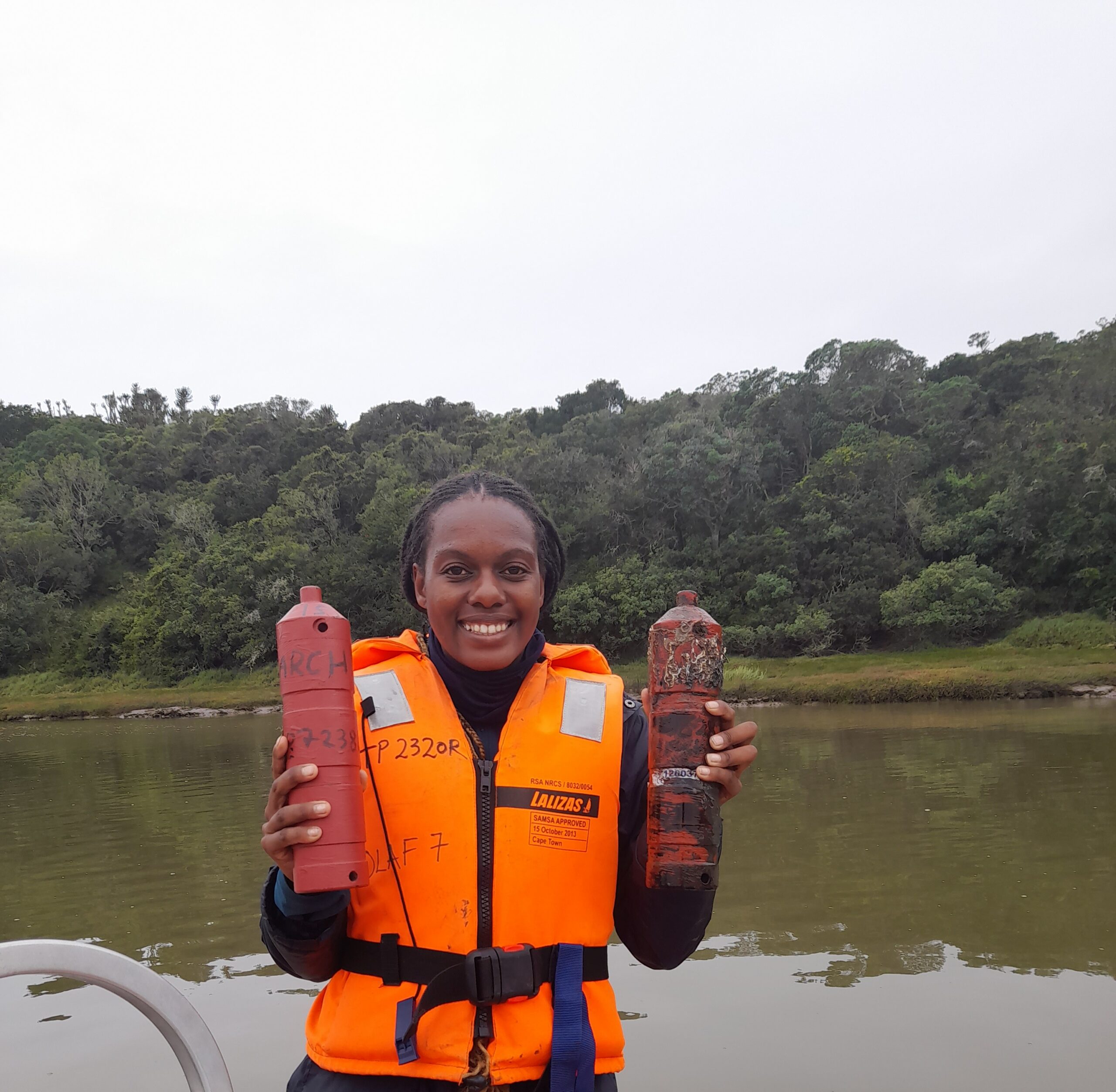
There is a group of fishes that dominate estuaries across the globe – the humble mullet. Not only are mullet of high fisheries value, but they also play a crucial role in aquatic estuarine food webs. Despite their social and ecological importance, relatively little research other than biological work, has been done on these species. We know what they eat, how big they grow, when they mature and their relative importance to the fishery, but, very little is known about their movement, and how they might be moving between different environments (e.g. between estuaries and adjacent rivers and sea). This is what newly graduated Dr Dinah Mukhari aimed to find out over a three-and-a-half-year period, specifically focusing on flathead mullet (Mugil cephalus) in the Kowie Estuary, Eastern Cape. Using three different methods, including acoustic telemetry, thermal tolerance laboratory experiments and otolith microchemistry, Dinah aimed to gain a better understanding of movements and habitat connectivity of flathead mullet linked to changes in temperature.
Acoustic telemetry, where fish are tagged with acoustic transmitters which give off sound signals and the signals are recorded by acoustic receivers placed throughout the estuary, was used to learn more about their fine-scale habitat use for one year. Fish generally moved throughout the estuary, with some individual variability, and at least half the tagged fish went to sea! Further, movements changed with a change in seasons, reducing the amount of estuary used during winter. Dinah also identified changes in movement in relation to river flow and water temperature, with fish moving towards the mouth of the estuary when river flow increased and river temperature decreased.
Laboratory experiments aiming to see the temperatures that flathead mullet could handle (either hot or cold, and called thermal tolerance experiments) were fairly representative of what Dinah saw in the wild. Even though they could handle temperatures as cold as 3.2 °C and as hot as 37.7 °C, the fish actually starting experiencing quite a lot of stress at 13.5 and 29.3 °C, temperatures that were quite similar to those actually recorded during the telemetry component of the project. So, the movement patterns observed in the telemetry component then made more sense given these lab experiments. But, what about their movements throughout their lives? Telemetry only provides a brief snippet of time (in this case, one year), so are their movements consistent over time, or does this change at some point?
Using fish ear bones (called otoliths) and taking measurements of the chemical composition of these otoliths at certain points, Dinah was able to figure out the environment in which flathead mullet were living through their lives. Once again, this aligned really well with the above two methods, showing that their movement patterns and the seasonal drivers behind these movements to and from the Kowie Estuary were consistent over time. Through the work conducted during her PhD, Dinah contributed immensely to the existing body of knowledge on mullet, and the flathead mullet in particular. She will continue her work on mullet through her Research Infrastructure Professionals Programme Postdoctoral Fellowship, where she is joining the Acoustic Tracking Array Platform (ATAP) team to capacitate the research team. While Dinah may have completed her thesis eight months ago, we wholeheartedly congratulate Dr Mukhari on a fantastic and well-received thesis, her graduation and officially becoming a doctor (!), and look forward to her contributions to the ATAP team during her time as an RIPP postdoc.